Showing posts with label Team work. Show all posts

How to train your Summer Student or Intern


We have already talked about how annoying some behaviors are when working at the lab, but there is something very important behind those behaviors: where did they learn to work (or not) like that.

I don't know how it works on your lab, but in my institute we sometimes have students that come for just one trimester, they are doing their bachelor studies and they get this great opportunity to see what working in the lab really is. Often PIs think of them as an extra pair of hands to work on a project, but it is important to remember that most of the time they have 0 experience and hence they must be trained properly.

The way you teach these students to work is what will (hopefully) stick to them. So let's discuss:

1. Teach them to work like you would like people around you to work.

Every time someone works without a lab coat and that bothers you, every time someone doesn't clean the transferring machine, think of the fact that they might not know better. Maybe they come from a lab where there was someone cleaning up after them. So, when the intern, summer student, etc, shows up, teach him to work in a way that would work with any team. No one will ever complain if the bench is "too" clean, or if all of the reagents are stored in the proper way.

2. Teach them to have an up to date lab book

I don't write on my notebook everyday; there are days where I can hardly manage to eat! But I have a day planner and I keep notes. The moment I have a bit of time down I pass everything to my notebook. The notebook doesn't have to be pretty. It has to be complete. This might seem like a little and non important thing to make emphasis when having a student, but think of that time you had to look for something on someone else's notebook and couldn't find anything. Wasn't it frustrating? Well, there you go.

3. Teach them the WHOLE protocol and the principle behind it.


As time passes by and you get more comfortable with a certain protocol you might discover shortcuts. This might work for you, but when teaching a protocol to someone for the first time it is extremely important that the person learns ALL the steps and then eventually learn the parts that can be played with (washes for example). To do this it is also very important that you explain the principle behind a protocol: why do you block with BSA? Why do you wash, etc? And this off course includes explaining what reagent A does. The amount of people that I have met that only know to add A to B, but have no idea that one is a lysis agent and the other stops the lysis (for example) is ridiculous.

4. Teach them to care for the lab

This implies caring about equipment, about the usage of the reagents in the proper way (storage at a certain temperature, if needs to be sterile, etc.) and about not wasting stuff. With the amount of cuts that a lot of universities are seeing all over the world this is extremely relevant guys. Recently a student left a secondary antibody that is supposed to be stored at 4 degrees, for almost a week on the bench. We received this antibody less than 2 months before, and it was practically untouched...and yet we have to order a new one. It might seem like a little thing, but these type situations add up and waste is never a good thing.

5. Teach them to be conscious of their work.


To keep all the proper controls, to know what they are looking for, to ask the right questions.

6. Teach them that they are not alone in the lab.


In very rare cases, you will not be the sole student of a lab, unless it is just starting or closing. But most of the time you will be sharing the space and reagents. Teach them to not just think of themselves while at the same time, prioritizing their project. It is nice to have help, but not at the expense of the project advancing.

7. Let them work

All theory won't do anything if they never actually learn how to use a pipette, to make a gel, etc. Off course you won't give them the last experiment of your article that you don't want to risk. But they can always do an extra gel, with extra samples. An extra control never hurt anybody. They are not in the lab to just rack tips of empty the trash cans. Not even to just read articles! They are there to learn how to work on a lab, so show them!

What else can you think off?


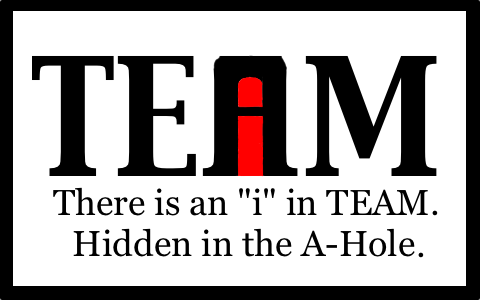
The I in Team is right in the A-Hole


You've seen or heard this before no? And working on science you have probably encountered say a-hole at least once. You might think this is a post for me to rant about the ones (yes I am using an S there) I have dealt with, but no. This post is intended to help you a. not to be the culprit and b. not to lose your mind with them.


Do your lab jobs.

First let's check: is everyone on you lab helping out? Are you helping out? Something that often goes unsaid is that, yes, research involves a lot of working by yourself, because no one else should be doing your experiments. But...what about the common tasks? Racking tips? Taking out the garbage? Checking that the incubators have enough water?

If your lab has a technician, maybe that person is in charge of most of these tasks, but even then there are always common tasks to be done around a lab. The question is: who is doing these tasks. If your answer is everyone but me, maybe is time to re evaluate your attitude. And no, don't tell me that you are busy, because we are all busy at a certain point. Find time to do your job. If ever you can't for X or Y reason, at least let the team now why there isn't any more aliquots of that reagent everyone uses or why you haven't send the tips to autoclave.

If you answer before was that you are the only one doing the lab jobs the first approach it talking to people. Now, this is a hard thing for me to suggest, because I hate confrontations, you have no idea; but I am talking from experience here: sometimes the person not doing her/his job hasn't realized it was their job on the first place. Try talking. If this doesn't work, you can always go a level up and discuss it with your advisor. The outcome of this conversation depends on the type of advisor you have, but it is also in their best interest that their lab works properly. The point is that you shouldn't be alone cleaning up people's messes. This will eventually affect you and your experiments and you certainly don't want that.

Offer to help

Sometimes you will see a person running all over the place trying to finish 4 experiments at a time. Ask if you can help with anything (if you have the time, don't offer help if you can't actually do it, this is worst) during the day. They won't give a valuable experiment that you have no training for, but maybe you can help washing their membranes, preparing a solution. This can change the whole day. But be careful; do not bite more than you can chew. Once again, don't jeopardize your experiments AND for the love of science, do not say you know how to do something if you don't. If the experiment is ruined because you "helped"...well buddy, better stay away next time.

Realize that you are not the only one with a "big" day

You get to the lab at 6am and planning to do your big experiment that uses common equipment for the whole day, say a centrifuge. But someone arrived at 4am and is already using it. You get mad off course, but then realize that you never reserved the centrifuge, you just "assumed" that no one was using it. Unless you are the only person in the lab that uses this piece of equipment/reagent DO NOT ASSUME. When planning a big day, figure out what are you going to need and when are you going to need it. Give yourself extra time, because you never know. Once you have done this, ask to the people that might use the same things if they are indeed going to use them at the same time than you are. Off course you cannot plan for everything, but you can do your best. Trust me, a bit of extra planning is better than arriving and realizing all of the cell culture hoods are taken and you can't start working until noon.

When everything fails...Breathe

At the end of the day, there will always be a person who deems themselves "to busy" to help out, or who just doesn't care. The latter are the worst in my own opinion, but anyway. Breathe once, breathe twice. And carry on. Sometimes, as awful as this might sound, even after the talking, reasoning, etc. the message won't come through and you might realize that it is healthier to take the trash down yourself. I am not saying to take all the lab jobs and run the lab alone. You shouldn't and honestly with a PhD project you couldn't. But being angry won't make your colleague listen to you any better. Instead try to calm down and later either talk to this person again or, something that has worked wonders for me, talk to the other people that are actually doing their jobs. You might feel at times that you are making the slacker's life easier if you take over the job, and this might be true in the short term. The difference is that you will be able to work on your project, finish and move to the next stage in your life while, and trust me on this one, this will come back to bite the other person's ass.

Learning how to work on a team is always an asset, and if this person just doesn't see it, she/he will remain forever the A-hole.


In the meantime, keep working on good science ;)