Showing posts with label SciComm. Show all posts

When "sexy" titles are misinforming ones


Today I want to talk about “sexy” headlines. You know, the ones that grab your attention and make you open that link? The ones that are too scary to pass by? Sadly, most of the headlines of this type, in science articles, might be eye-catching, but not fact checked.

Because a lot of the time the journalist writing that science piece in your local newspaper doesn’t have a scientific background, she/he might not have the impulse to corroborate certain statements with actual scientist. Think about the whole “red meat” ordeal: tons of “major” newspapers jumped on the news that processed meats could cause cancer. Please note that from the screenshots I’ve chosen, the term goes from cancer-causing, linked to cancer, cancer risk “do cause cancer” and cancer threat. All of these terms, for the record, are not interchangeable, but I’m getting away of the main problem. 

Some examples of headlines.


The fact that processed meats contain certain compounds that could increase the risk of developing a certain type of cancer (mostly associated to the gut) is not necessarily news to a lot of scientist, whether they work on cancer or not. Same goes for red meat. What was news was the fact the World Health Organization had added them to their list of carcinogenic agents. What people got from all these headlines? Eating red meat is bad for you, don’t do it or for sure you will get cancer. I even found an article titled: Vade retro, red meat (Vade retro, viande rouge), an article that, despite what you could’ve think based solely on the title, is not telling you to cut your red meat intake to 0.

Back to the scary headlines. That week I had to spend several hours with different members of my family (immediate and extended) explaining that, yes it was known, yes, it might increase the chances of developing a certain cancer, no, that piece of bacon you ate yesterday won’t cause cancer alone, no you don’t need to go vegan, yes, it’s a good thing to keep things in moderation.

There are several things that some (not all) of those articles didn’t discussed. The fact that processed meat is in the same category than asbestos and cigarettes, doesn’t mean they work in similar ways. As everything that is harmful to your body, the amount of exposure on your own body, alongside a panoply of other factors, will come to affect the effect of said carcinogenic agents. However, the articles that did mention this would often do so in the 4th+ paragraph, much after the big conclusion that red meat is evil and you are going to get cancer, OMG…you get the point. So people with the TL;DR attitude would never even notice these very important points. Once again, this type of approach creates panic and misinformation. I understand that it’s through the title that the writer grabs your attention first, but here we are talking about almost sensationalist journalism. In a society with a diminished attention span, you need to have a “sexy” title, sure, but just make it a trustable-fact checked one.

It doesn’t take a rocket scientist…or does it?

Last Saturday I was listening to the Nature podcast while working at the lab (wow, that sentence makes me sound like such a party animal, doesn’t it? Carry on) and through the episode, Davide Castelvecchi was talking about his profile on Shinichi Mochizuki and the mathematician’s proof to one of the most famous and important problems of the field. At a certain point, Castelvecchi explained that even though he has a PhD in mathematics and practically has spent his life learning and talking about the field, it would take him years to fully understand Mochizuki’s work. And so the question came to me: do you need to be an expert on a subject to talk/do a story about it?

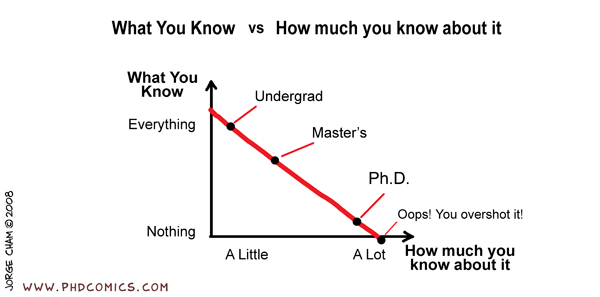
Now, the thing is, as you go on in academia, you go down a “rabbit hole” of specializations. Many scientist like to joke that we learn and learn about a subject until you know everything about nothing. We work on a single subject for years (between my masters and my PhD, I have been working on my subject for almost 6 years now), go to conferences related to it, talk and present and write, all the time talking about (mostly) one idea. Even when we go to interdisciplinary conferences, we tend to gravitate, if not anchor ourselves, around presentations that are directly or at least closely related to our thesis subject. While this is perfectly understandable, since we do want and need to know everything that is going on in our area, it means that often we miss out on very interesting developments in other fields. 
 
From PhDcomics.com
 

This vicious circle of specialization explains why only Mochizuki and maybe another few mathematicians, including the three only ones to have read his +500 (!) pages proof of the problem, would fully understand his research. But that doesn’t mean that only them would be capable to talking to others about it; the proof (ha, see what I did there?) is the very interesting, very clear profile that Castelvecchi gives us. Or to a lesser scale, the fact that I manage to explain the works of a zoetrope, even though the last time I dealt with optics and physics in general, was in my first year as an undergrad.

While one doesn’t need to be an expert on a subject to write a piece on it, independent on the level of vulgarization that you are aiming for, it does help to have a background in the field you are going to discuss. The reason why Castelvecchi manages to present to us this profile is not just because he is a good writer (he is), but it is also because he is a good scientist in the sense that he knows which questions to ask and to whom in order to grasp the concept and make it a whole think piece. The reason why so many science pieces in newspapers have many scientists shaking their heads is because, in more cases than we care to admit, those pieces are being written by someone with no scientific background, which means that not only the concepts might remain unclear but also misinformation arises.

So, does it take a rocket scientist to write about rockets? Probably not, but it doesn’t hurt and in fact should be the rule of thumb, that the person writing about rockets knows about rockets and contacts a rocket scientist for all the questions that might arise. The availability of the scientist to comment/help on the piece? That is a subject we will discuss on another occasion.


The role of Science Centers in Science Communication


The Science Center of Montreal.
Last weekend I had the opportunity to work as a volunteer at the Association of Science and Technology Centers (ASTC) annual conference. It was hard work with Saturday having me almost a full 12h on my feet (day started at 6h30) and Sunday being a full day as well, albeit, being only 8h. Was it worth it? 100% yes.

I’ve mentioned to you ad nauseam that I want to go into science communication, mostly as a science (or medical, we will see) writer. But off course, that is not the only way to share science. Science communication is obviously part of the mission of science centers, along with education and community building.

I will not talk to you about how different this congress was to more academic ones…I mean, I will, just not today. Today I want to talk to you about another point that I saw coming back during the conference and that is the relevance of science centers and programs. Allow me to tell you a story that might seem like going through the branches, but will help the discussion: as one of the talks finished, I had to wait for everyone to go out the room. At the same time, a woman in charge of cleaning the room approached me to ask what the conference was about (side note: she didn’t speak English or French, only Spanish, which is why she didn’t read the posters, and noticing my last name went for it). I explained to her that this particular talk was about making science centers more relevant to adults as well as to kids. She said: “Oh that is actually a good idea, because to be honest, I do think of sending my kids to museums to learn, but for me? The idea doesn’t seem interesting, it’s more of a children’s thing”

That is one of the great problems a lot centers and programs are encountering, and if we are being honest, research too. How to make science (as a whole, both in research and in communication of it) relevant to everyone; how to make this subjects stick to the public, independent of their age. How do we get them to care?

While the role of science communicators is getting stronger, there’s still a lot of ground to cover. Grabbing the attention of people is not always easy and specially in a society that, unfortunately, dismisses science more often than not, convincing people that it is worth their time and attention, is not evident. That’s where programs as Adult Only Nights at the Telus Spark, or the iNaturalist community events come in. When you involve the community and when you remind the adult of how much fun science can be, they get interested and they pass this interest on, not only to their children, but to their peers too.

Off course, this is not an easy task. It’s going to be almost a year since I started this blog, and while I do have a fair amount of traffic, getting people to participate has been a challenge. And that is only my personal experience. One of the issues that I am perfectly aware of, is that I haven’t manage to post as consistently as I would like to. Sure, finishing a PhD might have something to do with that, but still. Getting content ready and being able to grab people’s attention is still something I am working on. But now imagine the scale that Science centers have to work at. Wider communities, ages, etc. They have to keep renewing their programs and content and yet keeping it accessible and attractive for the mases. As you can imagine, it’s a big task. But they are doing it, they keep innovating and they keep helping researchers to get more people interested in science.

Let’s not forget science centers when we think of science communication. Have you visited your local SciCenter already? Tell me about your favorite exhibits and what makes them unique at communicating science!

What reading about The Pill made me think about SciComm


I recently finished reading "The Birth of the Pill" by Jonathan Eig (if you are interested in the review, you can see it here) a nonfiction about what it took for this, now, common contraceptive to be discovered and approved, at least in the U.S. It was an interesting read, both for me as a woman, a scientist and former user of the pill. But it got me thinking about the way Gregory Pincus, the main scientist of this endeavor, was portrayed, how he shared his research and how so many things haven't changed at all in science communication, even after 50 years.

Every time I read a science nonfiction it strikes me how more often than not, the scientist involved are portrayed as this cold, nonchalant men (let's face it, most of the time it's men) that looks to others with a hint of disdain. While I have to admit that a lot of current scientist still fit this profile, it was fun to read about Pincus eccentricities, albeit there are a lot of things in his behavior I do not approve, such us traveling or even paying his wife's shopping spree with the foundations money. But still, it was nice to see a scientist portrayed as having a social life, liking fast cars, etc.

The thing that struck me the most was probably how he approached sharing his data. In case you don't know this, he once worked in Harvard but after some controversy about his in vitro research, he was denied tenure and decided to go solo, founding the Worcester Foundation for Experimental Biology. It was here that most of his pill-related work took place. But here is the thing, Pincus was very open to non academic media about his advancements, even when technically, he hadn't succeeded yet. He criticized a lot of his fellows researchers who (to his eyes) where obsessed with only publishing in specialized journals and only in the most scientific terms.

This last part hasn't changed that much in academic science. There's still a prejudice against those who vulgarize their research and Impact Factors are still considered as badges of honor by a lot of scientist. You would think that in more than 50 years since Pincus (and others) criticized this tendency of researchers to keep research for themselves, more people would be open to sharing their findings and to making them more accessible to a bigger public. Alas, it's not the case.

Once again, I do not fully agree with the Pincus methods Telling a conference that his research is almost done when months and even years of data was still needed is basically lying, and trying to inflate your number by presenting them as number of cycles instead of number of women in a study is plainly wrong. But I think we can all agree that once your data is sound and tested, there is nothing wrong with approaching the "general" medias and serving as a bridge between your research and the general public.

Because of the constant fear of being scooped, I understand why so many of us are hesitant to share our research and even the process of your research. Someone even recently asked me if I wasn't afraid of getting scooped because I posted a picture of my "Experiments To Do" list on Instagram. Well, first of all the image is blurred out, but even if someone decides to invert the filter and then tries to make sense of my writing, this person would still need to find the same thread of thought I've been exploring for 5 years now. So, no, I'm not particularly worried about being scooped via IG. I am worried though that this paranoia has been present since forever in academia, and rather than making our results more accessible to everyone we are digging deeper holes to hide everything until it's "publication perfect" and then we only share it with a very small circle.

To read about how this SciComm issue hasn't advance that much in half a century is daunting. I am exaggerating off course. It is true that we have more people dedicated to communicate science in a much more open manner. Blogging and social media in general have helped. But the whole stigma in the scientific community against SciComm persists. Just as The Pill helped revolutionize the way people considered sex, maybe we are far due to changing the way people look at scientist and science in general.