
 |
| From: http://www.beatricebiologist.com/2014/05/autoimmune/ |
Two weeks ago I introduced to you some of the cells in the immune system. As I mentioned, these cells can identify if there is something foreign (a pathogen or another particle) that has entered our bodies and, after this recognition, can proceed to respond appropriately. This of course implies that our body, and more specifically, our immune system can recognize our own body from other. But what happens when the immune system cannot tell who should and who shouldn’t be around?
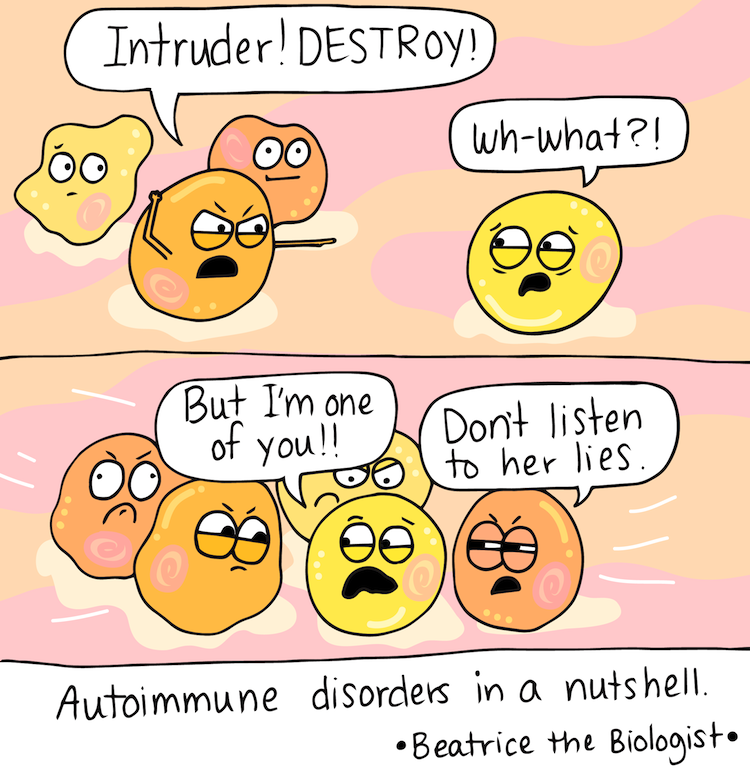
In very simple terms, an autoimmunity disease is the result of our immune system no longer recognizing our own body and then attacking it. When someone gets an organ transplant, one of the things that makes this so hard is that you have to find as close a match as possible so your immune system doesn’t attack it. Even with the best match possible, transplant patients have to undergo medical treatment to “distract” the immune system until it no longer registers this organ as new/foreign. Now imagine that a part, or parts, of yourself are being considered as foreign ALL the time. This would be an autoimmune disease.
You may ask, why then don’t we just treat this disease with the same medicine transplant recipients are treated with? Because sure, this could lower the attack of your immune system upon yourself, but this also lowers the response to actual infections. So you see, it is not as simple.
Autoimmune diseases can happen all over your body, in a particular area (Rheumatoid arthritis for example being located in joints) or affecting several systems at a time (Systemic lupus erythematosus commonly known as just Lupus for example, affects several internal organs). Because autoimmune diseases can vary so much, in how and where do they affect the body, it has been suggested to talk mostly about autoimmune disorders and consider them as a spectrum.
There are several ways an individual might develop an autoimmune disease, including genetic (such as Multiple Sclerosis) and environmental factors. In the latter case, exposure to other factors including bacterial or viral infection causes a normal immune response at first, which can then get out of hand if part of the pathogen looks a little too much like a part of our body: this is called molecular mimicry. I feel that it’s important to clarify that in the case of genetic factors, a person carrying a determined gene will have a predisposition to develop the disease but might never actually have it. Also, in some cases of environmental triggered autoimmune diseases, when the environmental factor is removed (say, the bacterial infection is cleared) the autoimmune response might disappear as well.
I hope this has simplified the concept of autoimmune diseases. If you have any more specific questions or you would like a follow up, please let me know in the comments. In the meantime, have a lovely week and keep doing good science.
In very simple terms, an autoimmunity disease is the result of our immune system no longer recognizing our own body and then attacking it. When someone gets an organ transplant, one of the things that makes this so hard is that you have to find as close a match as possible so your immune system doesn’t attack it. Even with the best match possible, transplant patients have to undergo medical treatment to “distract” the immune system until it no longer registers this organ as new/foreign. Now imagine that a part, or parts, of yourself are being considered as foreign ALL the time. This would be an autoimmune disease.
You may ask, why then don’t we just treat this disease with the same medicine transplant recipients are treated with? Because sure, this could lower the attack of your immune system upon yourself, but this also lowers the response to actual infections. So you see, it is not as simple.
Autoimmune diseases can happen all over your body, in a particular area (Rheumatoid arthritis for example being located in joints) or affecting several systems at a time (Systemic lupus erythematosus commonly known as just Lupus for example, affects several internal organs). Because autoimmune diseases can vary so much, in how and where do they affect the body, it has been suggested to talk mostly about autoimmune disorders and consider them as a spectrum.
There are several ways an individual might develop an autoimmune disease, including genetic (such as Multiple Sclerosis) and environmental factors. In the latter case, exposure to other factors including bacterial or viral infection causes a normal immune response at first, which can then get out of hand if part of the pathogen looks a little too much like a part of our body: this is called molecular mimicry. I feel that it’s important to clarify that in the case of genetic factors, a person carrying a determined gene will have a predisposition to develop the disease but might never actually have it. Also, in some cases of environmental triggered autoimmune diseases, when the environmental factor is removed (say, the bacterial infection is cleared) the autoimmune response might disappear as well.
I hope this has simplified the concept of autoimmune diseases. If you have any more specific questions or you would like a follow up, please let me know in the comments. In the meantime, have a lovely week and keep doing good science.
